 FR
 AR
 EN
 ES
 DE
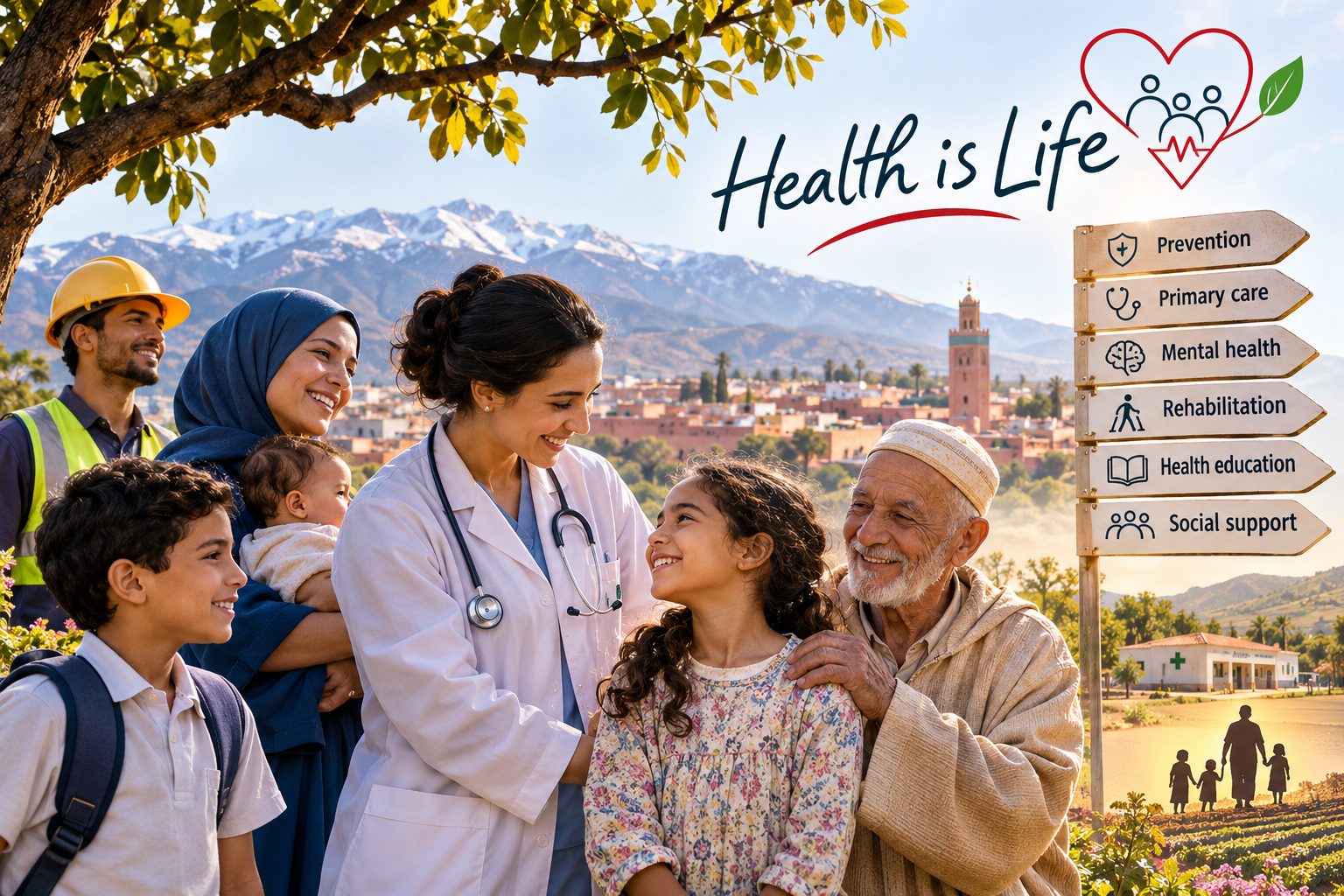
Dr Naima Benali explains in this artcile how Health is the foundation of human dignity, social justice and sustainable development. In Morocco, prioritising prevention, equitable healthcare and collective action is essential to building a healthier society where everyone can thrive.
“Health is not merely the absence of disease. Health is the possibility of living, developing, participating and belonging. Health is Life.”
A society is ultimately measured not only by its economic growth, infrastructure or technological progress, but also by the health and dignity of its people.
Health as the foundation of a strong, just and humane society
Health is Life
To say that health is life is to recognise that health is the foundation upon which human potential rests.
Without health, education becomes harder, work becomes harder, family life becomes harder, and participation in society becomes more difficult.
Health is therefore not simply a personal matter or a responsibility of the healthcare system. It is a fundamental social and political concern.
My thesis
Health must be understood as a fundamental investment in people and in society — not as a cost.
For Morocco, this perspective is particularly important.
The country is undertaking major reforms in universal health coverage and social protection.
These reforms create an important opportunity to move beyond access to insurance and toward genuine access to health: prevention, primary care, mental health, rehabilitation, health education and social support.
Health and social justice
Health inequalities often reflect wider social inequalities.
Where people live, their income, education, employment, housing, gender, social networks and access to information can all influence their health.
A child growing up in poverty does not begin life from the same starting point as a child growing up in security.
A person living in a remote rural area may not have the same practical access to healthcare as someone living in a major city.
Social justice therefore requires more than formal equality. It requires that people have a real opportunity to achieve and maintain good health.
From healthcare to a health society
Morocco needs to continue strengthening primary and preventive care.
The goal should be a health society in which prevention is valued as highly as treatment, and in which health is integrated with education, employment, nutrition, housing, culture, environment and social policy.
This calls for cooperation between government, local authorities, healthcare professionals, universities, civil society, businesses and the Moroccan diaspora.
Each has a role to play in building human capital.
A practical direction
One concrete approach would be to develop locally anchored community health centres that combine prevention, basic health screening, women’s and children’s health, mental health support, rehabilitation, health education and social guidance.
Mobile teams could extend these services to rural and underserved communities.
Such centres would not replace the formal healthcare system.
They would create a bridge between people, communities and healthcare — helping people before illness becomes severe and helping those who are vulnerable to remain included.
Health as a national investment
A healthy child has a better chance of learning.
A healthy adult has a better chance of working and contributing.
An older person who receives appropriate rehabilitation can remain independent for longer.
A person who receives early mental health support may return to work and community life.
Every one of these outcomes has both human and economic value.
Investing in health is therefore investing in Morocco’s human capital, social cohesion and long-term development.
A shared responsibility
Health is a human right, but it is also a shared social responsibility.
Governments have a duty to build fair systems.
Professionals have a duty to serve with competence and humanity.
Businesses can contribute resources and innovation.
Civil society can reach people who are otherwise excluded.
Communities themselves are essential partners.
The principle is simple: no person should become socially or economically abandoned because they become ill.
A vision for Morocco
A strong Morocco is not only a Morocco with stronger institutions and a growing economy.
It is a Morocco where people can live longer, healthier and more dignified lives; where children have a fair start; where women’s health is treated as a national investment; where mental health is part of ordinary healthcare; where rural communities are not left behind; and where prevention is at the heart of public policy.
Health is therefore not one sector among many.
From Healthcare to Health
We should not measure the success of a healthcare system only by how much healthcare it delivers, but also by how much healthcare it makes unnecessary.
The ultimate goal should not be to build a larger healthcare sector, but to create a healthier society.
The best health system is one that prevents disease, identifies health problems early and creates the conditions for people to remain healthy.
The greatest achievement of healthcare is not simply to treat illness, but to protect health before treatment becomes necessary.
Health is the foundation.
And because health makes it possible to live, participate, learn, work, love and contribute:
Health is Life.


Commentaires
Vous devez être connecté pour laisser un commentaire.
Aucun commentaire pour le moment. Soyez le premier à commenter !